All modules
    AI Visibility Intelligence

    AI Visibility Intelligence

    When someone asks ChatGPT or Perplexity about your category, does your brand get mentioned? AI Visibility Intelligence answers this across 8 AI engines with real numbers: per-engine breakdown, sentiment trend, and scan-over-scan change. Know before it shows up in your traffic.

    Visibility Trends Overview
    AI Visibility Intelligence report showing brand mentions and analysis.

    What this module does

    Each capability solves a distinct problem inside this module. Skim the list to see what ships out of the box.

    • Overall AI visibility score with per-engine breakdown across 8 AI engines (ChatGPT, Perplexity, Gemini, Claude, Grok, DeepSeek, Meta AI, GLM)
    • Sentiment analysis: know whether AI portrays your brand as positive, neutral, or negative
    • Trend tracking on your scan cadence (weekly, monthly, or on demand) so you catch drops before they become traffic problems
    • Historical visibility chart to correlate schema and content changes with mention rate shifts

    What you measure and what changes

    The metric this module tracks and the practical outcome you should see after a few cycles in a workspace.

    What you measure

    AI mention rate per platform

    What changes

    Visibility score moves when you ship the right content

    After updating schema markup or publishing targeted content, visibility scores show the impact within days. You see which AI platforms responded and whether sentiment improved alongside mention rate.

    Eight AI engines, one scan, one truth

    AI Visibility queries eight AI engines on every scan: ChatGPT (OpenAI), Perplexity, Gemini (Google), Claude (Anthropic), Grok (xAI), DeepSeek, Meta AI, and GLM. The same questions go to each one and the same logic reads each answer, so a mention on Perplexity counts the same way as a mention on Claude. When a new AI engine launches and matters for your audience, it shows up in your dashboards without you doing anything.

    Detecting whether your brand was mentioned uses three checks at once. The brand keywords you registered are searched as whole words in the answer. Your brand domain is searched as a substring inside the answer. Every source URL the AI cited is normalised and matched against your brand domain (multi-part endings like .com.tr and .co.uk are handled correctly). If any of the three trigger, the answer is logged as a brand mention.

    The same three checks run for every competitor you track, with one extra step: when an answer contains a numbered list, Brandop also records where each competitor placed. New competitors are discovered automatically too. AI search engines tell us who else they would suggest in your category, an LLM filters out directories, news sites, social platforms, and marketplaces, and named brands inside answer text are added to the list. You can always add a competitor manually if the auto-discovery missed one.

    Sentiment that reads what's said about your brand

    Most sentiment tools score the overall feeling of a paragraph. That misses the actual question: when AI mentions your brand, how is your brand described? Brandop scores each brand mention separately. When your brand or a competitor shows up in an answer, an LLM reads how that specific brand is described and returns positive, neutral, or negative for each.

    The same answer produces the same sentiment classification every time, so re-running a scan never gives you a different number on the same data. All brands in a single answer are scored together, so a large 50-question scan with four competitors finishes smoothly instead of trickling in. If the model has a hiccup the result defaults to neutral, so a single failure never poisons the trend chart.

    Sentiment shows up in three places: as a per-mention filter inside the citation list, as its own trend tab on the visibility chart, and as a positive-rate line for each AI engine over time. Combined with the won, overlap, and lost counts per engine, you can see which engines describe you well and which ones describe you incorrectly, side by side.

    A question library you actually own

    Visibility scans are only as good as the questions they ask. The library accepts AI-generated questions and questions you write yourself. AI-generated questions wait in a 'generated' state and only enter scans after you approve them. Questions you write are approved on entry and run in the next scan.

    Generation runs on Brandop's AI search engine when your plan supports it. Once a question is in the library, you can edit it, and the original wording is kept around so audits later can show what a question used to be. You can drag-and-drop to reorder, bulk-add (duplicates are merged automatically), and reject questions you decide not to track.

    Visibility scan history is not auto-purged. Activity logs roll over after 90 days and unapproved drafts after 10, but the scan rows themselves stay for the lifetime of the workspace. Year-over-year visibility comparisons are not blocked by retention rules.

    From visibility gap to a published article in three clicks

    A diagnosis without an action ramp is just a chart. Every tracked question carries a one-click handoff into Content Studio. Click the question, and the article wizard opens with the title and topic already filled in from the question text. You don't paste anything, you don't re-type the question. The wizard just continues from where AI Visibility left off.

    The five-step wizard (language, tone, mode, topic, preview) collapses to three steps because mode and topic are already known from the question. After that the regular generation pipeline runs: same scoring, same brand-voice rules, same brand-mention guardrail. A 'fill the gap' article does not bypass any quality checks.

    After publish, the next visibility scan tells you whether the question moved from a competitor to your brand or stayed lost. AI Visibility produces a polished PDF report of the result with per-engine breakdown, daily trend, sentiment totals, your best and worst performing questions, the citations and competitors that show up most often, and your competitive market-share rank.

    See it working

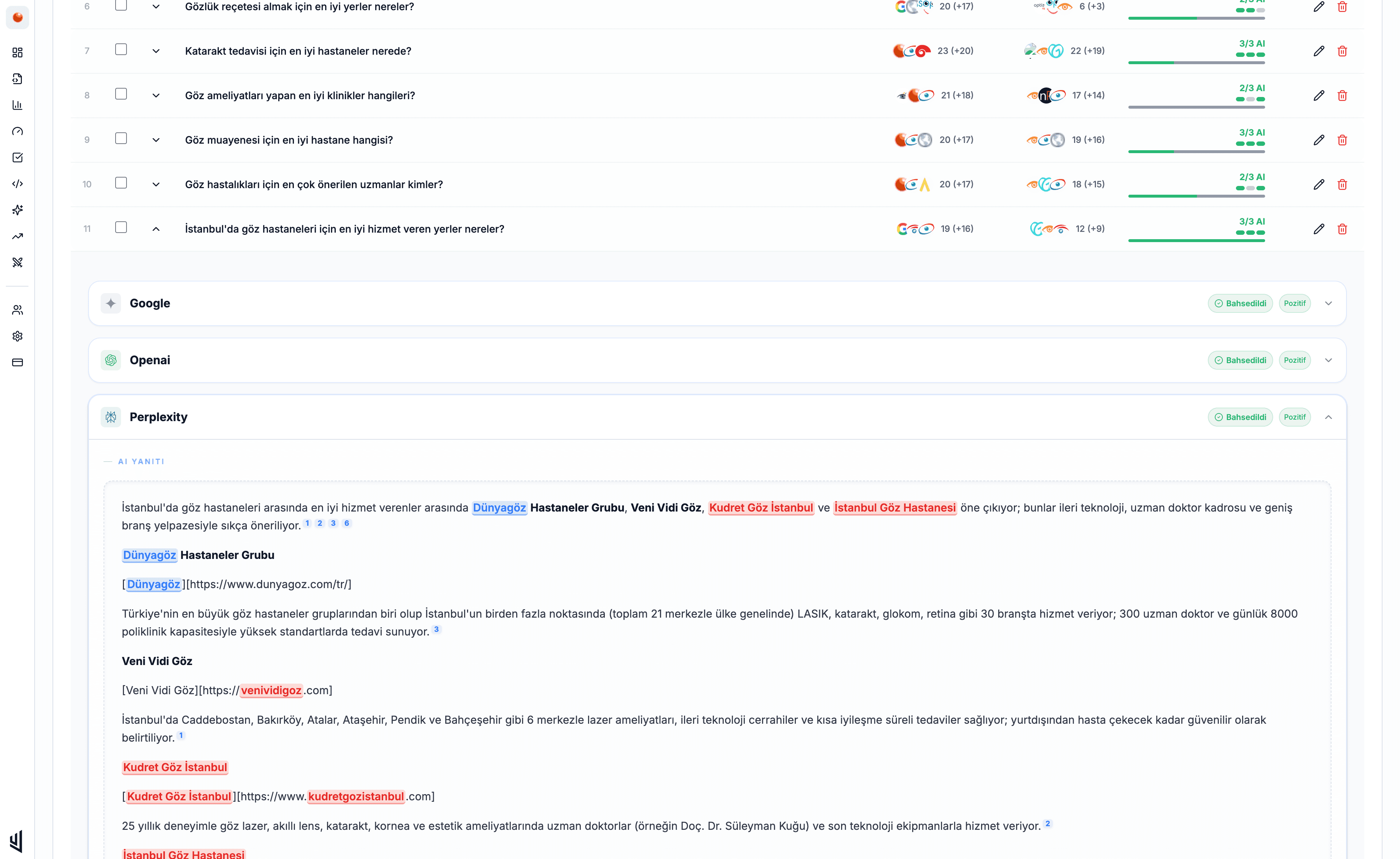
    The examples below show how this capability works inside a real workspace. No mockups. This is exactly what you see when you sign in.

    Next-Gen AI Discovery

    Be Visible When Customers Ask AI for Help

    When potential customers ask AI assistants for recommendations in your industry, will they mention your brand? Track and optimize your AI visibility.

    ChatGPT
    Perplexity
    Claude
    Gemini
    xAI Grok
    DeepSeek
    GLM
    Meta AI

    User asking AI:

    "Best luxury hotels with spa in Europe?"

    Industry: Hospitality

    ChatGPT
    Perplexity
    Claude
    Gemini
    xAI Grok
    DeepSeek
    GLM
    Meta AI
    Brand Mentioned in6/8AI Platforms

    Track Your Brand in AI Responses

    We analyze how AI platforms respond to industry-specific questions. When someone asks "Best hotels in Europe?", does AI recommend you?

    How It Works

    1. 1We analyze your website and industry
    2. 2Generate questions your customers would ask AI
    3. 3Query 8+ AI platforms and track if you're mentioned

    Industry-Specific Queries

    Questions tailored to your business and target audience

    Multi-Platform Coverage

    Track visibility across ChatGPT, Perplexity, Claude & more

    Sentiment Analysis

    Know if AI recommendations are positive or neutral

    The future of search is AI-driven
    Read More
    Global AI Landscape

    AI Search Engine Market Share by Country

    Discover which AI assistants dominate in different regions and optimize your AI visibility strategy globally.

    🇹🇷

    Turkey

    AI Search Engine Market Share

    ChatGPT
    94%
    Perplexity
    1.8%
    Gemini
    2.6%
    Copilot
    1.1%
    Claude
    0.3%

    Key Insight

    ChatGPT dominance. ChatGPT leads with 94% share.

    Global Trend

    ChatGPT leads with 70-94%. Perplexity growing fast.

    Source
    AI Visibility Intelligence | Brandop